👻 Can a Spirit Box Bridge the Gap Between Our World and the Spirit World?
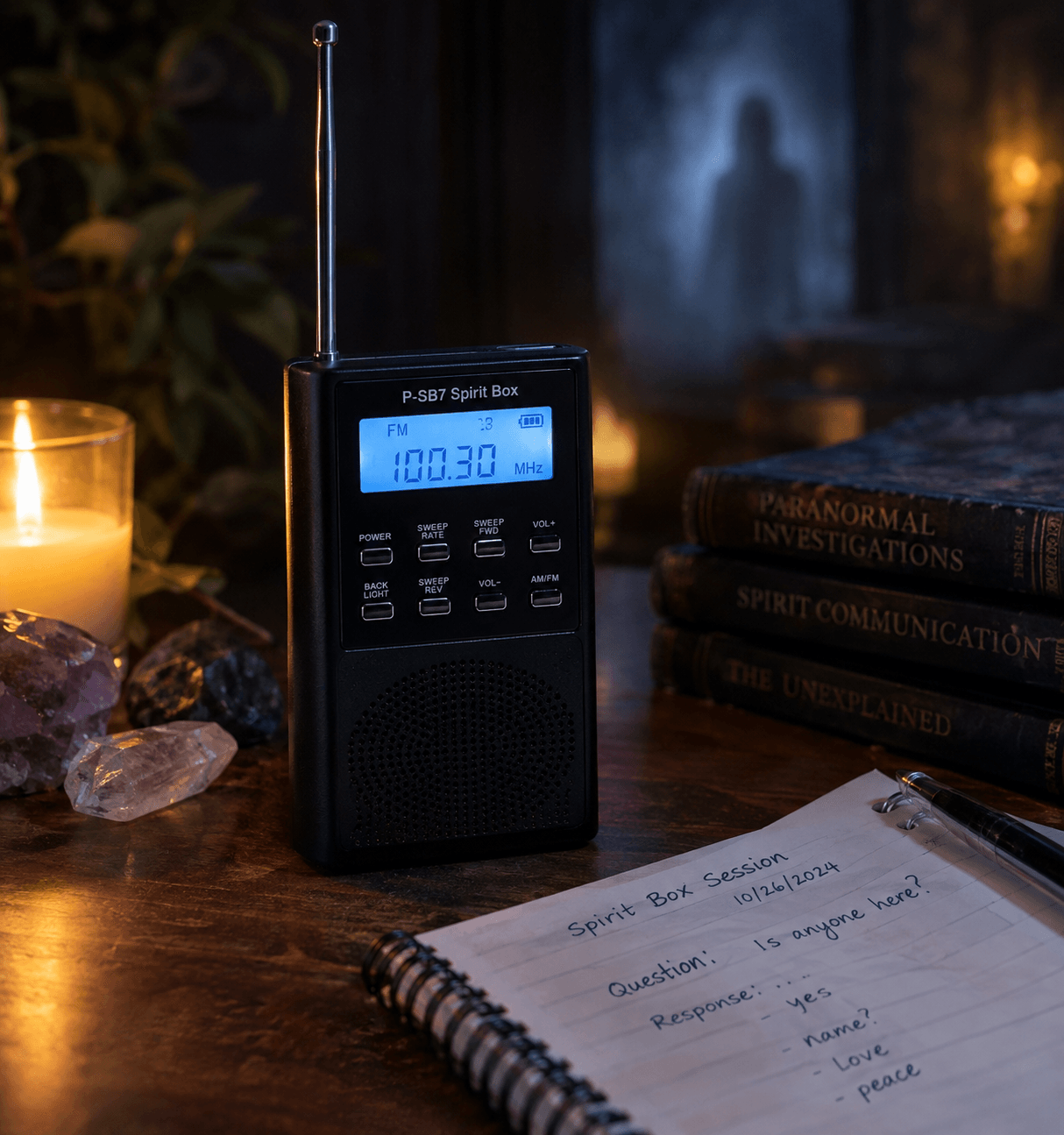
Have you ever wondered what might happen if you gave the spirit world a chance to speak?
Imagine sitting in a quiet room, asking a question, and suddenly hearing a word, a name, or a sound that seems to answer you. Was it a coincidence? A random fragment of sound? Or could there be something more happening?
Welcome to the fascinating world of spirit boxes — one of the most intriguing tools used in paranormal investigations and, in some cases, by spiritual readers seeking to explore possible communication with the other side!
🔮 WHAT EXACTLY IS A SPIRIT BOX?
A spirit box is an electronic device that rapidly scans radio frequencies, producing a continuous stream of changing sounds, voices, and fragments of speech. Paranormal investigators use these devices in an attempt to capture responses from spirits or other unexplained phenomena.
The idea is that a spirit may be able to communicate through the changing sounds, creating what investigators interpret as a relevant word or response to a question.
Picture asking, “Is anyone here with us?” and hearing what sounds like a quiet “yes” emerge from the static.
Chilling? Intriguing? Maybe a little of both!
Of course, spirit box responses can also result from radio broadcasts, background noise, and our brains naturally recognizing patterns in sound. That is why careful investigators look for context, document their sessions, and avoid assuming every apparent response is paranormal.
But that doesn't make the experience any less fascinating to explore!
✨ HOW PARANORMAL INVESTIGATORS USE SPIRIT BOXES
During an investigation, a spirit box may become one of several tools used to explore unexplained activity. Investigators might:
👻 Ask questions and listen for relevant words or phrases.
👻 Document unusual responses that seem connected to the location, people, or circumstances.
👻 Compare potential responses with other observations, recordings, and equipment readings.
👻 Look for patterns across multiple sessions rather than relying on a single unexplained sound.
For many paranormal teams, the real excitement comes from investigating the unknown, examining the evidence, and trying to understand what they have experienced.
And sometimes, it's the unexpected moment that leaves everyone asking, “Wait… did you hear that, too?”
🔮 CAN SPIRITUAL READERS USE A SPIRIT BOX WITH CLIENTS?
Absolutely, some spiritual readers and mediums incorporate spirit boxes into their sessions as an additional tool for exploration.
For a client hoping to feel connected to a loved one who has passed, the possibility of hearing a familiar name, a meaningful word, or something associated with a cherished memory can be deeply emotional.
A reader may use the device while asking questions, observing what sounds emerge, and discussing whether any responses seem personally meaningful to the client.
However, a spirit box cannot reliably verify that a voice belongs to a particular deceased loved one, and an apparent response should never be treated as proof of spirit communication. It is best approached as an exploratory tool rather than a guarantee of contact.
The most important part of any spiritual session is respect, discernment, and allowing the client to decide what feels meaningful without pressure or promises.
🌙 IS IT REALLY A SPIRIT… OR SOMETHING ELSE?
This is where things get especially interesting!
When a word seems to answer a question, how do we interpret it? How can we distinguish a meaningful coincidence from a possible unexplained experience? And what should we consider before using electronic equipment during spiritual or paranormal work?
These are questions worth exploring, especially if you're curious about mediumship, paranormal investigation, or the many ways people attempt to understand experiences beyond the ordinary.
My advice? Stay curious, keep an open mind, document what you experience, and maintain a healthy balance between spiritual exploration and critical thinking.
You don't have to accept every unexplained sound as paranormal to appreciate the mystery of what we don't yet understand.
🕯️ ARE YOU READY TO EXPLORE THE UNKNOWN?
Whether you're fascinated by paranormal investigations, interested in developing your spiritual awareness, or simply curious about the tools people use when exploring possible communication with the spirit world, there is always something new to learn.
At The Magick Medium, I love exploring the fascinating connections between mediumship, witchery, paranormal experiences, and the mysteries that encourage us to ask more questions.
What if the most interesting part of the spirit box isn't just what you hear, but how you investigate, interpret, and understand the experience?
I'd love for you to continue exploring these fascinating topics with me!
✨ Visit www.themagickmedium.com to discover more about my spiritual services and explore the mysteries of mediumship, witchery, and the paranormal.
Until next time, keep your curiosity alive, trust your discernment, and never stop asking questions about the unknown.
With a little mystery and magick,
The Magick Medium 🖤🔮

The Board in the Dark: Why the Ouija Still Whispers to Us
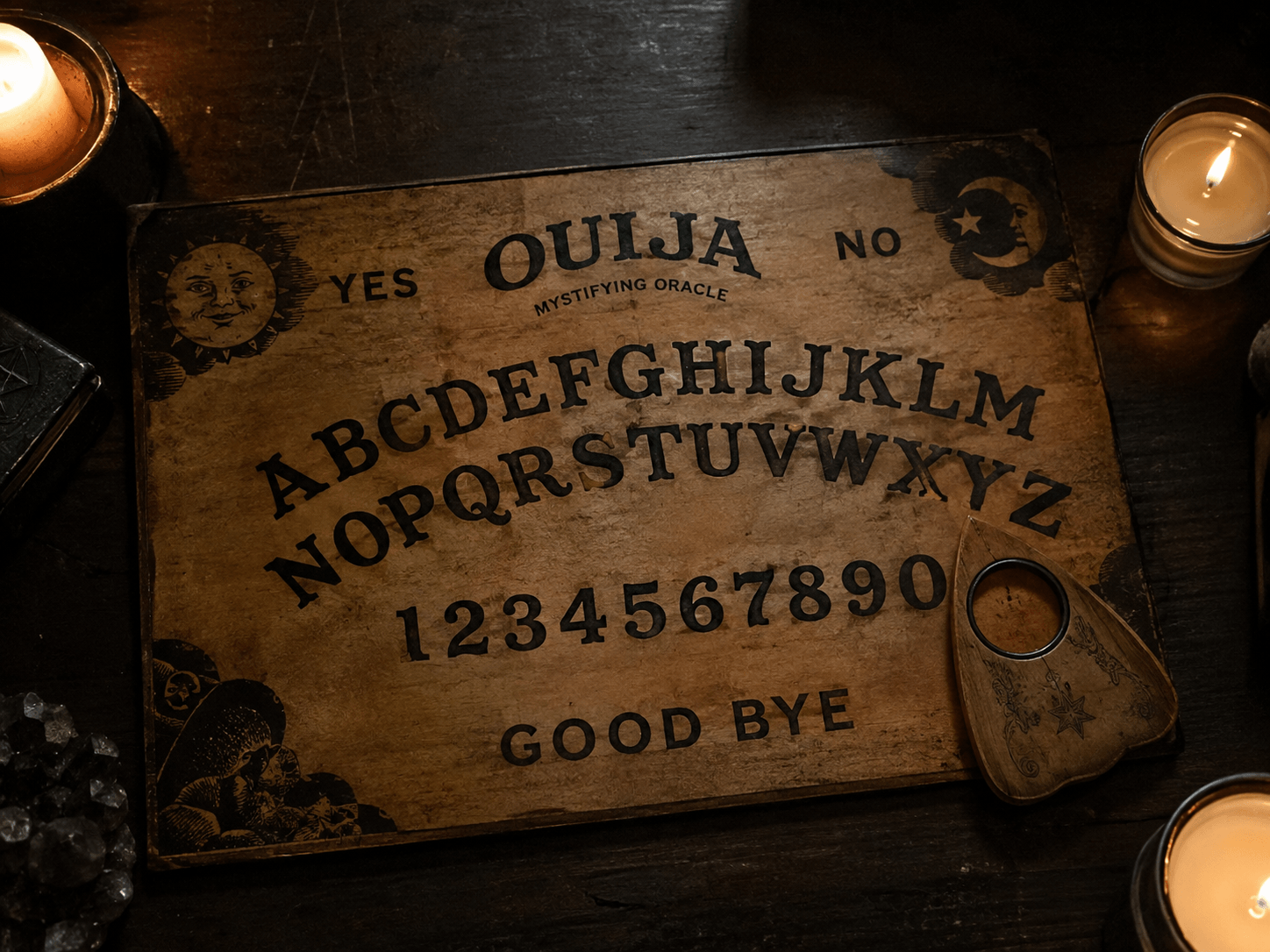
There is a distinct, heavy stillness that takes over a room the moment a talking board is laid flat on a table. The air grows thin, conversation drops to a whisper, and every shadow seems to stretch just a little longer.
Of all the tools in the ghost hunter's kit, none carries a darker reputation or a heavier aura of taboo than the Ouija board. But is it genuinely a portal to hell, or is it simply a tool—no different from the blinking lights of a REM-Pod or the crackle of a spirit box? To understand the board, you have to peel back the layers of sensationalism and look at where it came from, why it terrifies us, and how it actually fits into modern paranormal work.
A Born-in-the-Parlor Legend
Before it became a staple of horror cinema, the spirit board was born out of profound grief and human curiosity. In the late 19th century, the Spiritualist movement swept across North America. Devastated by the heavy losses of the American Civil War, thousands of families were desperate for any sign that their fallen loved ones were still alive somewhere in the ether.
Early mediums used tedious methods like table-tipping or automatic writing to channel messages from the dead. Seeing a commercial opportunity, businessman Elijah Bond and investor Charles Kennard patented a sleek, wooden board marked with letters, numbers, and a teardrop-shaped planchette in 1891. According to lore, when the founders asked the board what it wished to be called, the planchette spelled out O-U-I-J-A and claimed the word meant "good luck".
For decades, it wasn't viewed as demonic; it was sold in toy stores alongside board games as a harmless, mysterious parlor game for cozy family evenings.
The Architecture of Fear
So, how did a Victorian novelty item turn into a nightmare in a box?
Enter 1973 and the release of The Exorcist. Almost overnight, pop culture reshaped how society viewed the Ouija board. A narrative took root that the board acts as an unmonitored "open doorway"—a beacon that invites unpredictable, sinister entities into your home without an invitation code.
That fear isn't entirely baseless in the minds of researchers. Ask any seasoned investigator, and they will tell you the real danger of a spirit board isn't the wood and plastic—it’s intent and psychological vulnerability.
When people use a Ouija board, panic feeds on itself. Skeptics point to the ideomotor effect—unconscious, involuntary micro-movements of the muscles—to explain why the planchette glides across the polished finish. But whether guided by subconscious energy, telepathy, or an unseen spirit, the psychological weight is real. Fear lowers your guard, invites chaos into an investigation, and leaves sitters open to trickery—human or otherwise.
Just Another Tool in the Case
Strip away the Hollywood horror music, and a spirit board is simply a focused conduit for communication.
Paranormal investigators spend thousands of dollars on high-tech gear. They use electromagnetic field (EMF) detectors to spot localized spikes, spirit boxes to sweep radio frequencies for spirit voices, and trigger objects to entice active responses.
Yet, when you break down what these tools actually do, the Ouija board functions on the exact same fundamental principle: it provides a language matrix.
A spirit box gives spirits a voice through audio white noise.
An EMF meter gives spirits a binary "yes/no" trigger via raw electromagnetic energy.
A talking board gives spirits a visual alphabet to spell out direct thoughts.
In modern field research, the board is an analog, physical interface. Just as an investigator wouldn't run a spirit box session without setting firm boundaries, you don't touch a board without strict protocol. Grounding the energy in the room, setting explicit rules of engagement ("You may answer our questions, but you may not attach to anyone here"), and closing the session properly with a clear "Goodbye" are the paranormal equivalents of turning off your equipment at the end of a night.
Opening the Door
The Ouija board remains a lightning rod in the paranormal community because it demands direct engagement. You can't sit back passively and watch a digital display screen; you have to put your fingers on the planchette, quiet your mind, and wait in the dark.
History Hit
It serves as a stark reminder that in spirit communication, the most sensitive piece of equipment isn't powered by batteries—it's the human consciousness sitting at the table.
Have you ever gathered around a board, felt the wood slide beneath your fingertips, and wondered who was really steering the message?
Built with systeme.io
Create Your Free Account